In-App Messaging

Nicole Kennedy
Marketing Director
Turning App Users Into Conversions
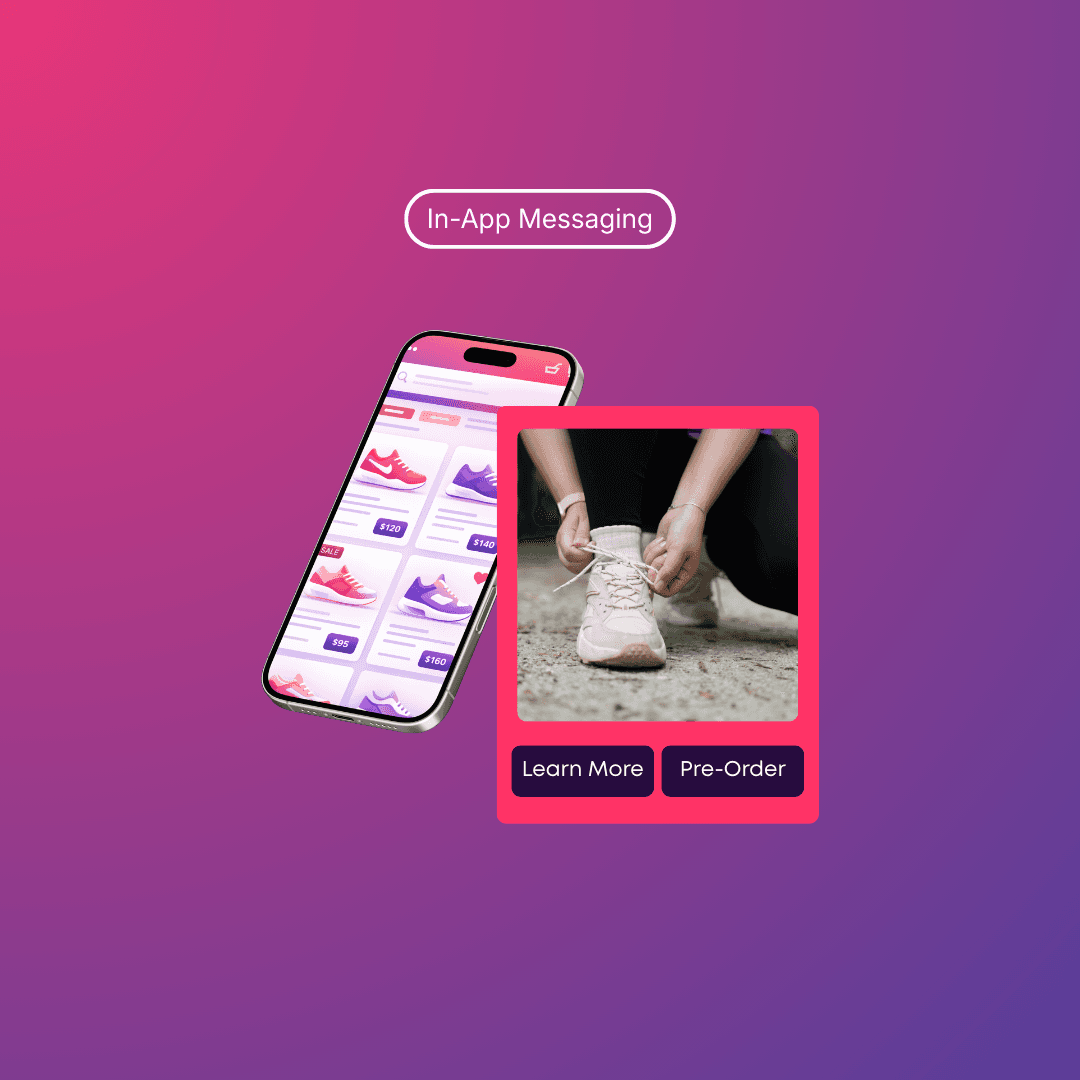
In-app messages (IAM) are one of the most powerful tools in a customer engagement strategy. They are targeted messages that appear while users are actively using your app. They are contextual, timely, and when used well, they influence behavior at the exact moment it matters.
While in-app messaging is an effective engagement channel, one factor consistently amplifies performance: video. When video becomes the asset inside an in-app message, engagement deepens, frictions, reduces, and conversions increase.
Why IAM is so Effective
Unlike email or push notifications, in-app messages reach users while they are already engaged. There is no need to win back attention from another environment or channel. In-app messaging operates in context and context drives action.
This immediacy allows brands to:
Introduce new features during onboarding
Promote upgrades at natural decision points
Highlight time-sensitive offers
Guide users through product discovery
Prevent churn with timely support
What Changes When You Add Video
Static banners and text can communicate a message. Video communicates momentum, clarity, and intent. Here’s what typically changes when video becomes the asset inside an in-app message.
1. Comprehension improves and decision time shortens
Video accelerates understanding.
Research consistently shows that marketers overwhelmingly believe video improves product comprehension, with approximately 96 percent agreeing that video helps audiences understand offerings more effectively. Media studies also demonstrate that video holds attention longer than static formats.
Mechanism:
Video delivers layered sensory input through motion, sequencing, and optional sound. This reduces the cognitive effort required to interpret a message. Instead of reading and mentally assembling meaning, users see the benefit demonstrated. That clarity reduces hesitation and shortens the path to action. In in-app messaging, where users are often making micro-decisions, faster understanding directly supports higher conversion.
2. Engagement and Click-Through increase
Across digital marketing channels, video consistently drives stronger engagement than still images or GIFs.
Industry data shows emails that include video increase click-through rate of up to 65 percent or more. Embedded or interactive video formats have also been reported to lift click-to-open rates by 200 to 300 percent compared to text-only or basic media formats. While in-app performance varies by use case, the same principle applies.
Mechanism:
Auto-play video reduces friction. Users do not need to decide whether to press play. The content begins instantly, delivering value immediately and overcoming the inertia that often stops static creative from converting. Inside an app environment, where users are already active, this effect compounds.
3. Conversions and Revenue increase
Beyond engagement, video directly impacts commercial outcomes.
Marketing surveys show that up to 84 to 87 percent of brands report video increasing sales or return on investment. In some campaign scenarios, replacing static creative with video has delivered click or conversion rates up to three times higher.
Mechanism:
Video captures attention and improves understanding simultaneously. When both of those drivers increase, users are more confident and more motivated to act. In-app messages already benefit from contextual timing. When video is introduced into that context, the channel shifts from informational to decisional. In-app messages create opportunity and video converts opportunity into measurable action.
Where Video Works Best In-App
In high-impact moments, video can significantly improve performance. Short, clear, and focused videos perform best.
Consider using video for:
Feature launches
Subscription upgrades
Premium content previews
Seasonal campaigns
Personalized product recommendations
Guided onboarding milestones
Conversion Uplift
Well-timed in-app messages already outperform many outbound channels in driving user action. Increased outcomes come from one simple principle: users understand faster, feel more confident, and act sooner.
When video is introduced as the creative asset, brands commonly see:
Increased click-through rates
Higher feature adoption
Improved subscription upgrades
Reduced onboarding drop-off
Stronger repeat engagement
Making Video Scalable Across Channels
One challenge teams face is operational complexity. Creating, testing, and optimizing separate video assets for email, mobile, and in-app can quickly become resource-intensive. This is where delivery infrastructure matters.
Platforms such as Playable make it possible to deploy instant-play video across channels including email, in-app messaging, SMS, and push notifications without rebuilding assets for each environment. When the delivery system is streamlined, teams can focus on strategy rather than troubleshooting formats.
This allows teams to:
Maintain consistency across channels
Reduce production duplication
Test and optimize more efficiently
Scale high-performing creative with less friction
Best Practices for Video In-App Messaging
To get the maximum impact out of video in your in-app messages:
Use contextual in-app triggers: Display video in-app messaging at meaningful moments like when a user logs in and reaches their dashboard, or when a user pauses on a key screen.
Keep video short and clear: Aim for videos that communicate a single message or call-to-action within 10-20 seconds.
Include a strong specific CTA: End your video in a way that clearly tells users what to do next, but make it specific. Use “Start 7-day Free Trial,” instead of “Start Free Trial” or “Shop The Latest Collection,” instead of “Shop Now.”
Conduct A/B testing: Use variants to compare creative approaches, as small creative differences can significantly affect engagement and conversion.
The Playable x Braze Solution
The Playable and Braze integration provides a unified video delivery system designed specifically for Braze users. It simplifies the process of authoring and deploying video and related assets across multiple customer engagement channels, while maintaining high-performance delivery through Playable’s instant-play technology. Supported channels include Email, SMS, MMS, RCS, WhatsApp, In-App Messages, and Push Notifications, all supported within the Braze platform.
Release 1.0 of the Playable and Braze integration will support all major email clients. Additional channels will become available in Q1 2026 as part of Playable’s broader multi-channel roadmap.
By using a single video delivery system connected directly to Braze, marketers can configure consistent customer experiences across channels, networks, and devices. This approach reduces the time, cost, and operational effort typically required to create, test, and optimize video for cross-channel campaigns.
Ready to include In-App messaging into your customer engagement strategy?
If you are exploring how to incorporate instant-play video into your in-app messaging strategy, book a strategy session with our team: https://calendly.com/chelsea-albright-playable/30min?month=2026-01